

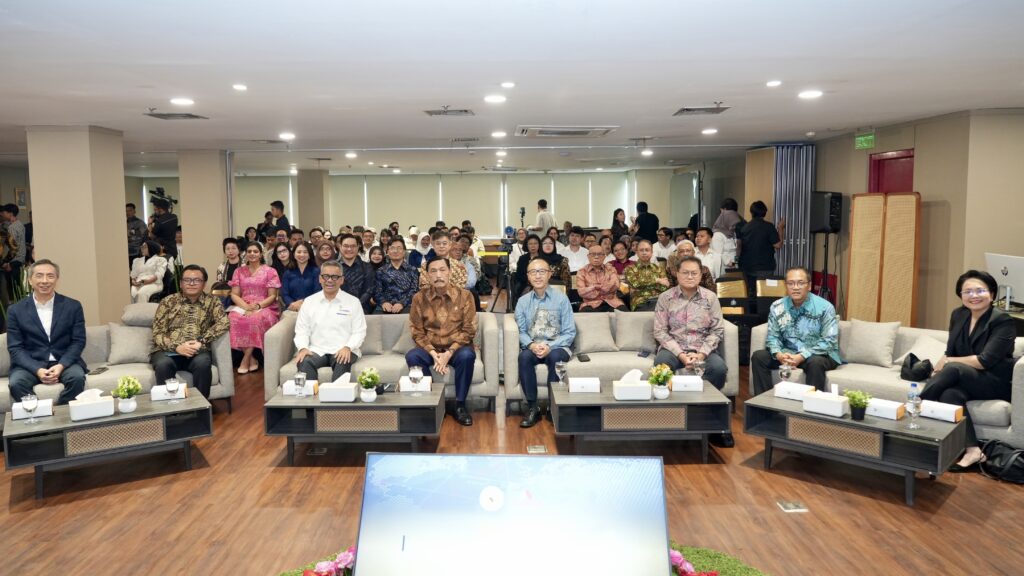
JAKARTA, INDONESIA, May 25, 2026 — AMRO and Indonesia’s National Economic Council (DEN) jointly convened a high-level seminar today, “Navigating Global Uncertainty: Sustaining Growth and Stability in ASEAN,” as part of AMRO’s outreach for its flagship publications—the ASEAN+3 Regional Economic Outlook (AREO) 2026 and ASEAN+3 Fiscal Policy Report (AFPR) 2026.
Bringing together policymakers, academia, private sector representatives, and international organizations, the seminar provided a platform to exchange views on the regional economic outlook and fiscal policy priorities amid heightened geopolitical tensions, economic fragmentation, and renewed external risks, including energy price volatility.
The event featured keynote remarks by senior Indonesian officials, presentations on regional economic and fiscal developments, and panel discussions on policy trade-offs and opportunities for deeper regional cooperation.
In his keynote address, DEN Chairman Luhut Binsar Pandjaitan underscored the importance of proactive policy responses to global uncertainty. “Global challenges are becoming increasingly complex, spanning economic and geopolitical dimensions. The ASEAN+3 region faces significant risks, including spillover effects from the conflict in the Middle East, particularly given our reliance on energy and critical commodities. While Indonesia remains well-positioned, supported by strong economic fundamentals and robust domestic demand, ASEAN+3 must continue to evolve as a strategic partner in safeguarding regional stability and promoting sustainable growth.”
Indonesia’s Vice Minister of Finance Suahasil Nazara highlighted the role of fiscal policy in navigating current challenges. He said: “Strengthening ASEAN integration is essential as the region faces shared challenges, from trade tensions to the disruptive impact of artificial intelligence. As uncertainty is becoming the new normal, it must be managed proactively. Adaptive and flexible fiscal policy is therefore crucial to sustain growth while maintaining fiscal discipline, including keeping Indonesia’s budget deficit below 3 percent of GDP.”
Drawing on the findings of AREO 2026 and AFPR 2026, discussions focused on how ASEAN+3 economies, including Indonesia, can navigate successive shocks while preserving macroeconomic and financial stability alongside sustained growth.
AMRO Chief Economist Dong He noted: “The ASEAN+3 region enters this period from a position of relative strength, but resilience cannot be taken for granted as the balance of risks remains tilted to the downside. Preserving policy flexibility will be essential to navigate uncertainty, while deeper regional integration and stronger policy coordination can help support more sustainable and resilient growth.”
In closing the seminar, AMRO Deputy Director Abdurohman said: “With fiscal positions weakened and policy space narrowed following successive shocks, safeguarding sustainable and rebuilding buffers will be critical. At the same time, strengthening fiscal management—including spending efficiency, strategic resource allocation, and revenue mobilization—will help economies better respond to future challenges and support sustainable growth.”
Attended by around 130 participants, the seminar strengthened engagement with stakeholders in Indonesia and reaffirmed the importance of regional dialogue and AMRO’s continued role in supporting ASEAN+3 economies through rigorous surveillance, policy advice, and regional cooperation.
About AMRO
AMRO is an international organization established to support macroeconomic resilience and financial stability of the ASEAN+3 region, comprising members of the Association of Southeast Asia Nations (ASEAN) and China; Hong Kong, China; Japan; and Korea. AMRO’s mandate is to conduct macroeconomic surveillance, support regional financial arrangements, and provide technical assistance to the members. AMRO also serves as a regional knowledge hub and provides support to ASEAN+3 financial cooperation.
About Indonesia’s National Economic Council (DEN)
Indonesia’s National Economic Council (DEN) is a premier advisory body established to support the national economic resilience and structural transformation of the Republic of Indonesia, comprising top-tier economists, industry leaders, and policy experts. DEN’s mandate is to review macroeconomic challenges, accelerate cross-sectoral deregulation, and provide independent, data-driven economic counsel directly to the President. DEN also serves as a strategic think tank and provides responsiveness to real-world economic issues within society and the private sector to ensure the achievement of the government’s priority programs.