
The ASEAN+3 outlook has improved since AMRO’s June Interim Update, despite the continuing Middle East conflict. Stronger-than-expected AI-related demand has lifted the region’s growth prospects, while a lower projected global commodity price path has improved the inflation outlook.
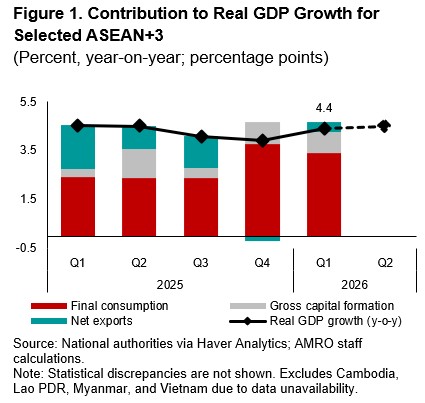
1. ASEAN+3 maintained solid growth momentum in the first half of 2026 despite the onset of the Middle East conflict. Household spending remained firm, supported by favorable labor market conditions and continued income growth, particularly in ASEAN economies (Figure 1). Investment also held up, particularly in advanced manufacturing and digital services. Disruptions to energy and input supplies due to the conflict appear to have weighed less on activity than initially feared.
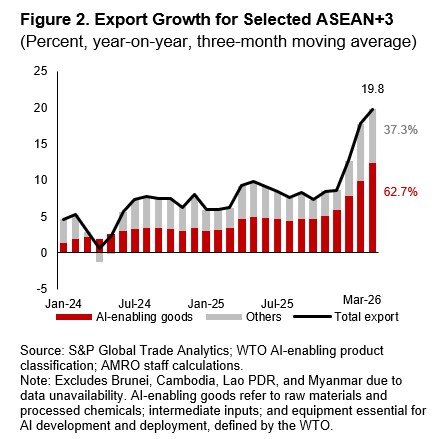
2. The region sits at the center of the global AI trade, which has become an important source of export growth. With around half of global AI-related trade running through the region, AI-related exports have contributed around two-thirds of export growth in the first quarter of 2026 (Figure 2). Global AI investment and semiconductor demand have so far remained robust, and the AI cycle is expected to continue supporting regional exports and growth.
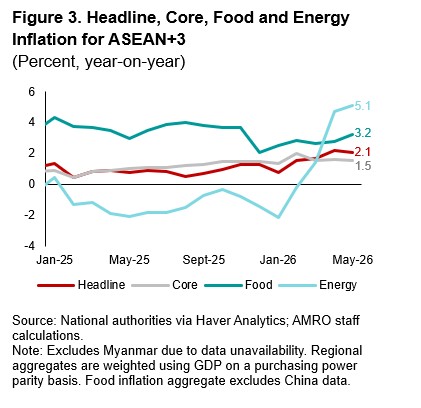
3. Inflation has remained broadly contained. While headline and core inflation rose following the onset of the Middle East conflict, price pressures have since eased alongside a moderation in commodity prices (Figure 3). Inflation has remained concentrated in energy and transport, although food prices could come under pressure as higher input costs and adverse weather conditions feed through to consumers.
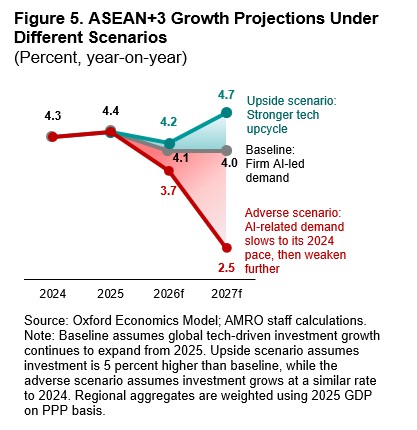
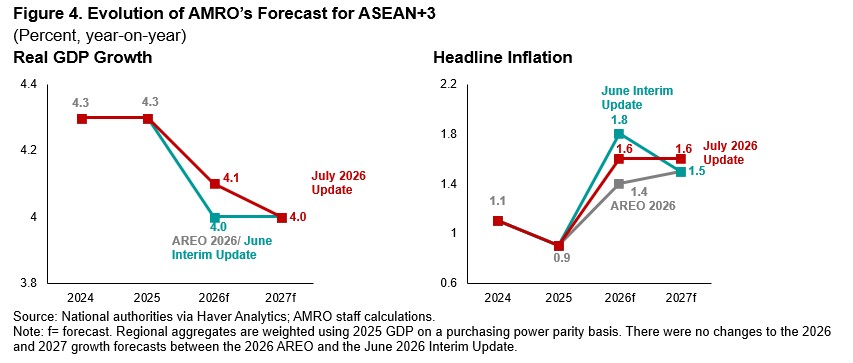
4. Stronger AI-related demand and a lower projected commodity price path have improved both the growth and inflation outlook. Growth in 2026 has been revised up to 4.1 percent, while inflation has been revised down to 1.6 percent (Figure 4). Growth and inflation are expected to be sustained at 4.0 percent and 1.6 percent, respectively, in 2027.
5. Significant uncertainty persists. A renewed escalation of the Middle East conflict could drive up energy, shipping, and food costs, while the AI cycle has become a key swing factor for the outlook. Growth in the region could slow to 2.5 percent in 2027 – the weakest outside the pandemic years since the Asian Financial Crisis – in a scenario in which global AI investment growth returns to its 2024 pace (Figure 5). Heightened financial market volatility and rising trade protectionism pose additional risks. Importantly, these risks could interact and reinforce one another, amplifying their impact on the region’s economic outlook.