

Fiscal policy in ASEAN+3 is entering a more complex phase. After several years of strong fiscal support to weather successive shocks, policymakers are now facing a challenging balancing act: safeguarding fiscal sustainability, rebuilding buffers, and meeting rising demands in an increasingly uncertain and fragmented global environment.
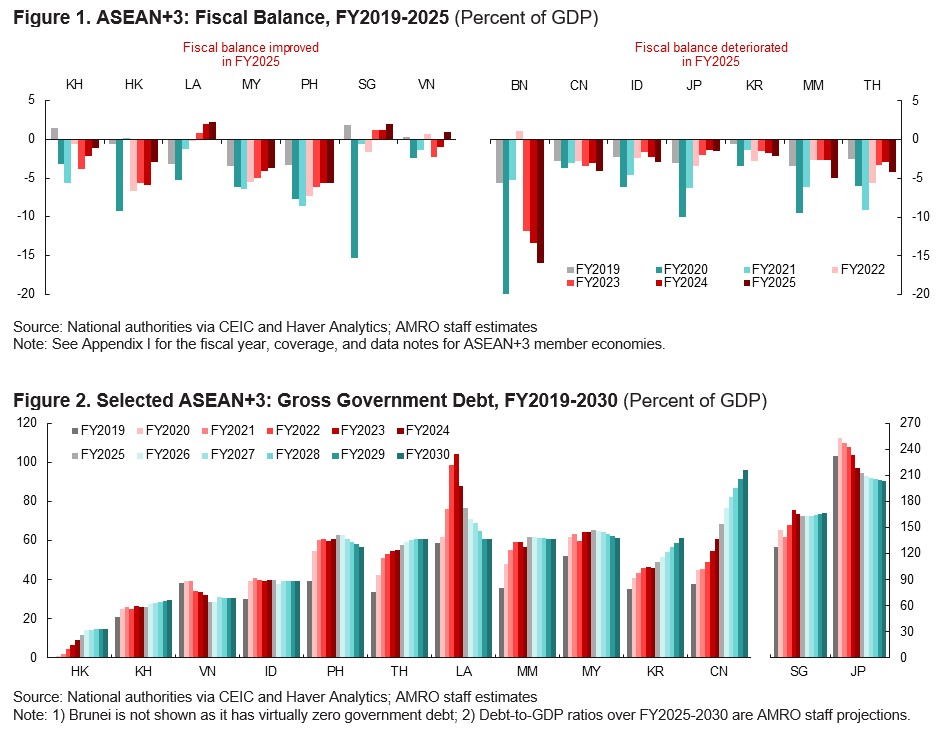
Over the past year, ASEAN+3 economies have continued to pursue active fiscal policies, notably by expanding spending to boost domestic demand, mitigate cost-of-living pressures, and cushion the impact of trade-related shocks. Fiscal outcomes in 2025 varied across member economies—with half showing improvement and the other half deteriorating—but remained generally weaker than pre-pandemic levels (Figure 1).
Government debt increased again in 2025, following earlier signs of stabilization, while financing needs remained elevated, reflecting higher principal and interest payments on accumulated debt (Figure 2). These developments highlight the need for continued policy efforts to safeguard fiscal sustainability.
Amid persistently high economic uncertainty, restoring fiscal buffers has become increasingly important. Member economies were widely recognized for their effective fiscal responses to successive shocks since the pandemic, supported by prudent policies in earlier years. However, this has also led to a narrowing of fiscal space, underscoring the need for sustained efforts to rebuild buffers and safeguard resilience against future shocks.
Near-term risks remain elevated, driven by potential tariff escalation and continued volatility in global energy prices, particularly if geopolitical conflicts in the Middle East intensify or persist. Should these risks materialize, fiscal policy will need to remain agile and flexible to mitigate adverse impacts while preserving economic stability.
Beyond short-term risks, authorities face mounting pressures to use fiscal policy to support growth, facilitate structural transformation, and reduce poverty and inequality over the medium to long term. Slowing potential growth and persistent income disparities across the region are likely to intensify demands on fiscal resources to support both pro-growth initiatives and redistributive measures.
However, revenue mobilization has not kept pace with rising expenditure needs. In many economies, budget structures have also become more rigid—partly due to rising interest payment obligations—leaving fewer resources available for priority spending.
Addressing these challenges requires further strengthening of fiscal management frameworks across key areas, including fiscal aggregate management, strategic resource allocation, spending efficiency, revenue mobilization, and risk management.
Fiscal aggregate management can be strengthened by establishing credible fiscal anchors to guide medium- to long-term fiscal aggregates onto a sustainable path. These anchors can be operationalized through well-designed fiscal rules and medium-term fiscal frameworks.
Within the fiscal envelope anchored by fiscal aggregate management, strategic resource allocation should be strengthened through medium-term planning and coherent annual budgeting. Spending priority should be given to growth-enhancing sectors—such as infrastructure, education, and research and development—while also reinforcing social protection system to reduce poverty and inequality.
Strategic allocation can also drive structural transformation, enhance economies’ resilience, and help turn challenges—such as population aging and climate change—into opportunities for sustainable growth.
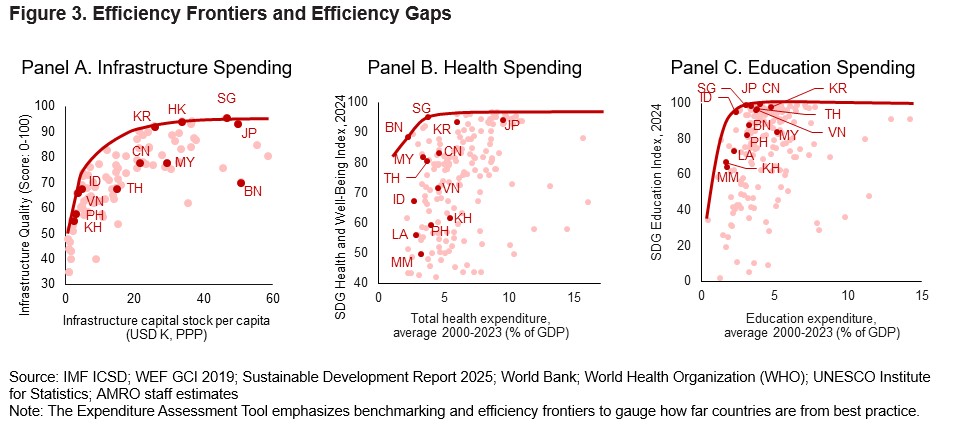
Improving spending efficiency is equally important to maximize the impact of limited fiscal resources. Efficiency gaps remain in key sectors such as infrastructure, health, and education across member economies (Figure 3). Addressing these gaps requires embedding performance management throughout the budget cycle, strengthening public investment management, and bolstering institutional foundations for effective budget execution.
Revenue-enhancing measures should be pursued in a comprehensive and durable manner. Strengthening tax administration—particularly through digitalization—will be critical to narrowing compliance gaps and improving efficiency. More rigorous management of tax expenditure is also needed, given the widespread use of exemptions and incentives across the region, which often erode the tax base without clear evidence of effectiveness. Durable revenue mobilization will require structural reforms to major tax instruments aligned with evolving international standards, including the global minimum tax.
Systematic management of macroeconomic and fiscal risks is also crucial. As uncertainty persists, enhancing the systematic management of macroeconomic risks—through contingency planning, stakeholder engagement, and transparent communication—has become increasingly important.
Fiscal risk management should place greater emphasis on the identification, assessment, and disclosure of risks, particularly those arising outside traditional budget coverage. Contingent liabilities require close monitoring and proactive management, especially those related to government guarantees, public-private partnerships, state-owned enterprises, and social security obligations, which can pose significant fiscal pressures if left unaddressed.
As ASEAN+3 economies navigate emerging risks and structural headwinds, strengthening fiscal management will be critical to enhancing resilience and supporting sustainable and inclusive growth, while safeguarding fiscal sustainability.