
Generative AI (GenAI) is no longer an abstract concept or a niche experiment; it has been quietly assimilating into daily routines from business and education to software design and social media. Large Language Models such as ChatGPT, Grok and DeepSeek are not only answering questions, but also generating content, transforming how we process and use information.
Unlike earlier automation waves, which replaced manual, repetitive, or highly structured tasks, GenAI is entering creative and cognitive domains once thought to be safe havens from machines. Global studies have found that roles with heavy routines are most vulnerable to displacement, while those requiring judgment, creativity or empathy are more likely to be augmented by GenAI.
Tasks that previously took hours now take minutes, often with greater efficiency and accuracy. Studies show that tools such as ChatGPT reduces task time by approximately 40 percent and improve quality by nearly 20 percent. GitHub Copilot has also delivered similar productivity gains in software development. The economic impact is significant, with AI projected to add trillions of dollars to global GDP by 2030.
This rapid shift raises a central question: will AI eliminate jobs or empower workers? Clerical roles—data entry and secretarial work—are most at risk due to their structured nature. In contrast, jobs requiring judgment, creativity or empathy—such as managers, educators and analysts—are more likely to be augmented, not replaced, by AI.
Disruption will be uneven in many economies: mid-level, codifiable roles face greater automation risk, and women, overrepresented in clerical and service jobs, are especially vulnerable. Physically demanding jobs—often requiring fewer qualifications—remain less exposed, while highly qualified workers with complex responsibilities are harder for AI to fully replicate.
Brunei’s labor market: a case study
A recent AMRO study of over 3,200 job tasks highlights how AI could reshape Brunei Darussalam’s workforce through automation and augmentation, reflecting global dynamics with local nuances.
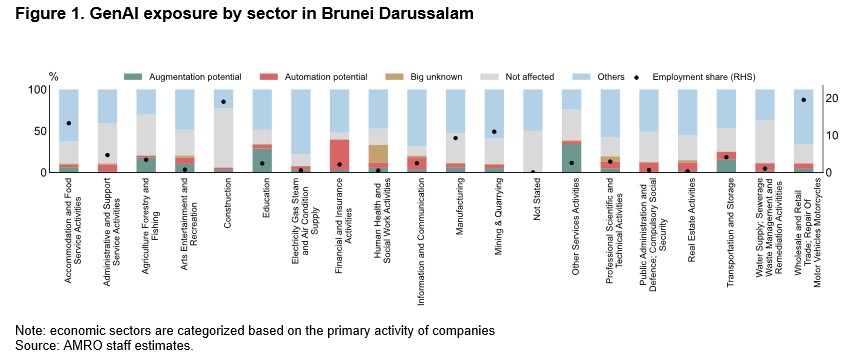
The high-income economy is more exposed to GenAI than lower-income peers due to robust digital infrastructure and a concentration of cognitive jobs. Finance and insurance sectors are likely to see the most transformation, while education and transportation will experience more augmentation (Figure 1)—AI supporting rather than replacing workers.
AI offers an opportunity for oil-dependent Brunei to accelerate diversification, unlocking growth in tech-enabled services, education and innovation-driven industries. The challenge is not to resist change, but to shape it. Managed well, AI can boost productivity and create better jobs without deepening inequality.
Policy priorities for an AI-driven future
Looking ahead, the focus is shifting from GenAI to Artificial General Intelligence (AGI) and embodied AI—systems with human-like versatility, which could dramatically expand the scope of automation. Complex problem-solving, tacit knowledge, and even aspects of creative judgment could become replicable, reshaping entire professions, not only specific tasks. While AGI’s timeline is uncertain—some experts predict decades away, others suggest as soon as 2030—the swift adoption of AI in everyday tools suggests change will come quickly. Simultaneously, rapid advances in AI-powered humanoids with sophisticated physical abilities are set to revolutionize labor markets worldwide.
Proactive preparation is essential. In economies where job stability and human interaction are valued, AI disruption may be slower but is still inevitable. To stay ahead of the curve, policymakers and businesses should:
- Monitor change: Regularly track AI’s impact on labor market through surveys and employer feedback.
- Upskill workers: Promote broad-based reskilling and upskilling, particularly for at-risk groups.
- Support transitions: Strengthen social safety nets for workers and create pathways for re-employment in evolving industries.
- Ethical governance: Promote responsible AI adoption by employers, addressing algorithmic bias and safeguarding inclusive growth.
The future of work in the age of AI is about shaping technology’s impact on society, not fearing it. The choices made today—in Brunei, across ASEAN+3 and globally—will determine whether AI becomes a catalyst for shared prosperity or a driver of deeper divides.