

In July 2026, Korea became one of the first major markets to rein in single-stock leveraged exchange-traded funds (ETFs). Regulators suspended new listings, banned their marketing, and raised the minimum deposit required to trade them. The measures followed a burst of market volatility that many blamed partly on the funds’ tendency to buy into rallies and sell into declines.
Korea is an early test case for this fast-growing product. Its experience raises a question that other markets are also confronting: do leveraged ETFs make markets more volatile?
How leveraged ETFs work
A traditional ETF holds a basket of assets—such as all the stocks in an index—and trades like a single share. It aims to track the index at low cost, making it suitable for buy-and-hold investors.
A leveraged ETF has an additional objective: to deliver a multiple—say, 2x—of an index’s return each day.
Delivering a daily multiple requires the fund to adjust its exposure at the end of each trading day, a process called rebalancing. A 2x fund does not simply invest twice its money in the underlying asset. Instead, a fund with $100 in net assets builds $200 of exposure by combining holdings of the underlying asset with derivatives such as total return swaps.
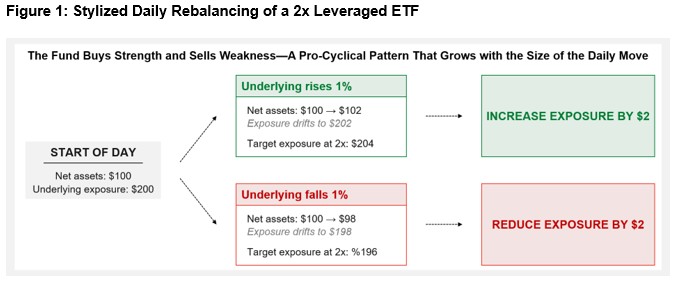
As prices move, this ratio changes, so the fund rebalances at the end of each trading day (Figure 1):
- If the underlying rises by 1 percent, the fund’s net assets grow to $102. Maintaining 2x leverage requires $204 of exposure, but the market move has lifted its existing exposure to only $202. The fund buys an additional $2.
- If the underlying falls by 1 percent, the fund’s net assets fall to $98, requiring only $196 of exposure to maintain 2x leverage. The fund sells $2.
The pattern is mechanical: the fund buys after prices rise and sells after they fall. The bigger the market move, the larger the required trade.
This mechanism applies to all leveraged ETFs. For a broad index fund, the rebalancing trades are spread across many stocks. A single-stock leveraged ETF applies the same mechanism to one stock, making the resulting flows far more concentrated.
Why leveraged ETFs are back in the spotlight
Leveraged ETFs were once a niche product. They are now large enough to attract wider attention, for two main reasons.
Their share of daily trading is growing rapidly. In the US, their largest market, leveraged ETFs’ daily rebalancing is estimated to have roughly quadrupled since early 2026, reaching about $50 billion a day—equivalent to nearly 1.6 percent of all S&P 500 futures trading.
A new, more concentrated form has emerged. Single-stock leveraged ETFs, which track an individual stock rather than an index, are among the fastest-growing products. First launched in the US in July 2022, they have spread quickly, with many tied to semiconductor and AI stocks.
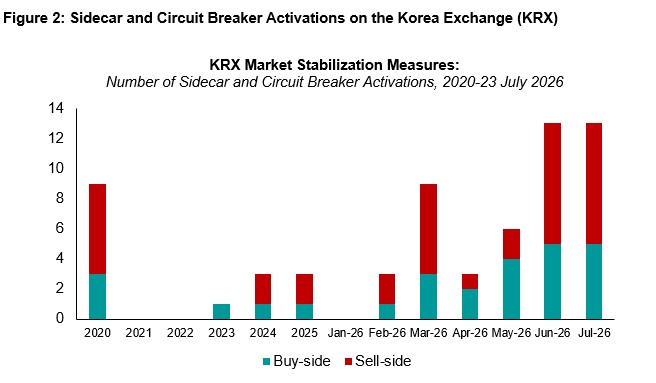
Korea illustrates how concentrated the trading can become. On May 27, 2026, 14 single-stock leveraged ETFs tracking Samsung Electronics and SK Hynix began trading, alongside two inverse ETFs linked to the same stocks. On peak days, their turnover reached around 40 percent of total KOSPI turnover, even though their combined assets remained below 1 percent of the two companies’ market capitalization. The products also entered a market that was already unusually volatile (Figure 2).
Do they really make markets more volatile?
The honest answer is that it depends—particularly on whether other market flows offset the rebalancing and how concentrated the fund is.
One view is that leveraged ETFs do add to volatility. The concern centers on rebalancing: because the fund must buy after prices rise and sell after they fall, its trades can amplify market moves in both directions. Two features can magnify this effect.
- When a single-stock ETF tracks a company with a large index weight, movements in that stock can affect the broader index.
- Rebalancing tends to occur near the market close, and the likely direction of trade can often be anticipated. Fast, automated traders—including foreign high-frequency trading firms—can position themselves ahead of these flows, potentially magnifying price movements.
On stressed trading days, leveraged ETF flows can move in the same direction as falling prices, adding to the decline.
Others see these concerns as overstated. Investors in leveraged ETFs often behave in a contrarian manner, buying after prices fall and selling after they rise, so their activity may partly offset the fund’s rebalancing trades. Broad, index-based leveraged funds may also have little market impact because their trades are spread across many stocks.
The evidence remains mixed. But recent experience suggests that, even with some offsetting activity, a single-stock leveraged ETF can add to volatility in the underlying stock—and, if that stock has a large index weight, in the broader market as well.
The bottom line
Three lessons stand out.
- Concentration matters more than the leveraged mechanism alone. A broad-index leveraged ETF may leave a modest market footprint. A single-stock fund can have a much greater effect, especially during sharp market declines, when offsetting flows may be weakest.
- Investors should treat these products as short-term trading tools. Returns over several days can diverge sharply from the stated daily multiple, particularly in volatile markets, making leveraged ETFs generally unsuitable as passive, buy-and-hold investments—especially when they track a single volatile stock.
- Policymakers need to match the response to the risk. Korea’s measures—pausing new listings, raising deposit requirements, and tightening price-tracking rules—primarily seek to cool investor demand. A useful complement would be to address the rebalancing mechanism itself, for example by spreading trades over a longer period rather than concentrating them at the market close.
But overly restrictive rules could backfire by pushing investors toward less-regulated products overseas—the very outcome Korea is seeking to prevent. As one of the first major markets to face this trade-off, Korea will provide an early test of how best to strike the balance.