

Keynote speech by
Dong He1, Chief Economist, AMRO
ADB-AMRO-JIMF Conference on “Fiscal and Monetary Policies in Developing Economies for Navigating Fragmentation Risks”
July 28, 2026
Introduction
Dear colleagues,
Good morning. Thank you for joining us today. It is a great pleasure for AMRO to co-organize this Journal of International Money and Finance (JIMF) conference with ADB. The topic could hardly be more timely, given today’s heightened uncertainty and fragmentation risks.
The theme of today’s conference is macroeconomic policies for navigating fragmentation risks. AMRO was established by the ministries of finance and central banks of the ASEAN+3 region precisely to safeguard macroeconomic and financial stability, with balance-of-payments risks at the center of our mandate. So today I would like to share some thoughts on exchange rate management, which has always been a key component of macroeconomic management for regional economies.
We are now nearly three decades past the Asian Financial Crisis. Since then, the region has built considerably stronger resilience — deeper reserves, more flexible frameworks, and more developed financial markets. Yet from our policy dialogues with central banks over the years, a recurring concern persists: even under more flexible regimes, exchange rate movements can become explosive when markets are under stress. Depreciation, once it starts, may not self-correct; it may instead beget further depreciation. In light of rising uncertainty and geoeconomic fragmentation, it is worth taking a fresh look at how the exchange rate’s role has evolved, and at what lessons can be drawn from the region’s experience.
My speech is organized in four parts. First, I will show that regional trade and business cycles have become more regionally anchored, while exchange rates remain strongly dollar centric. Second, I will explain why this matters: the traditional trade channel has weakened, while the financial channel has strengthened. Third, I will present new empirical evidence on the conditions under which exchange rate movements amplify shocks to domestic financial conditions. Fourth, I will draw out what this means for exchange rate management in practice, including how regional central banks’ experience relates to the BIS’s Macro-Financial Stability Framework (MFSF) and the IMF’s Integrated Policy Framework (IPF). Note that I will only focus on the role of foreign exchange intervention (FXI) and will not discuss its relationship with monetary policy and other policy instruments such as macroprudential policies or capital flow management measures.
A central message of my speech is that Asia’s experience offers a practical roadmap for operationalizing Integrated Policy Frameworks. While the IMF provides the normative criteria for when FXI is justified, and the BIS illuminates the global financial cycle channels through which shocks propagate, Asian central banks demonstrate how to combine both in practice: deploying tactical FXI during acute amplification events, while relying on structural market deepening as the permanent, non-depletable shield.
Part 1: What We Observe
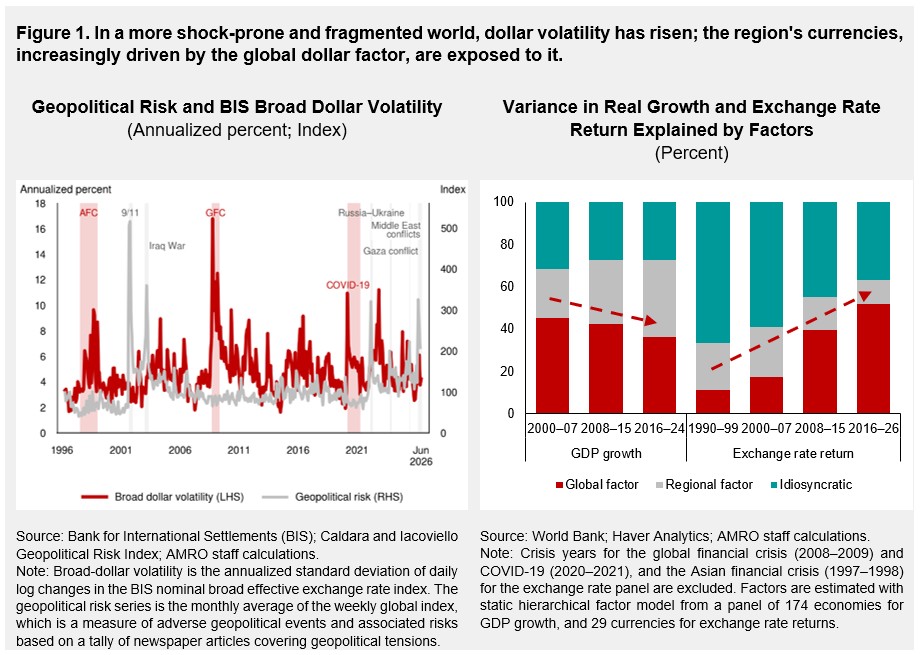
The first observation is that dollar volatility has become more important for regional currencies in a more shock-prone and fragmented world. Spikes in exchange rate volatility were historically associated mainly with major financial and economic events, most notably the Global Financial Crisis. More recently, however, dollar volatility appears to move more closely with geopolitical uncertainty, suggesting that currency markets are increasingly exposed to shocks that originate outside the traditional macro-financial cycle (Figure 1, left panel).
Market reactions over the past year—to events ranging from the tariffs imposed by the US administration to conflict in the Middle East—underscored a simple reality. When uncertainty originates elsewhere, investors seek safety in dollar-denominated assets. But when questions arise about the stability or predictability of US policies and institutions, concerns inevitably emerge about the dollar’s stability.
Thus, in a fragmenting world, dollar volatility may remain structurally elevated — driven not only by traditional financial shocks but increasingly by geopolitical uncertainty.
The second observation I want to share is a divergence between trade patterns and exchange rate developments in the region. The region’s trade and economic activity have become much more regionally anchored – intra-regional trade has deepened, supply chains are more integrated, and business cycles have become more synchronized among regional partners. But when it comes to exchange rates, the picture remains dollar centric. The global dollar factor dominates exchange rate returns – and has actually grown in importance over time (Figure 1, right panel).
Because regional currencies remain strongly influenced by the dollar, they are exposed to higher dollar volatility. Market concerns about currency volatility also tend to coincide with large external shocks—dollar swings, US monetary policy shifts, or global market turmoil—making the financial channel increasingly important. This contrasts with the traditional view that exchange rates affect regional economies mainly through the trade channel, given the region’s role as the world’s factory and its orientation toward Western demand. Understanding the changing relative importance of these channels is therefore essential. That is what we turn to next.
Part 2: Why It Matters
In the second part of my speech, I will review how the exchange rate’s role has evolved and how exchange rate movements now transmit to the economy.
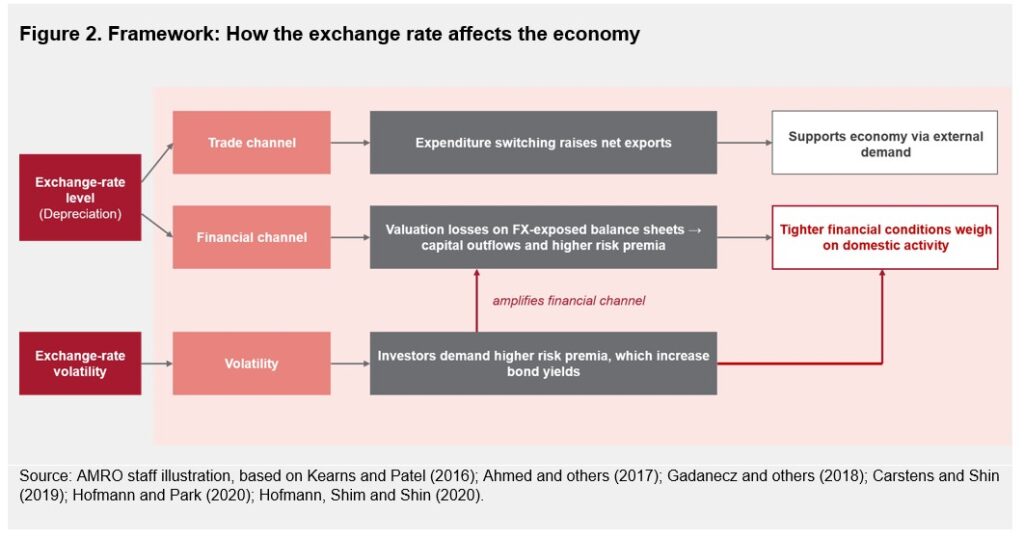
As we know, the level of the exchange rate affects the economy through two channels (Figure 2). The trade channel is well understood: depreciation works through expenditure switching, supporting the economy via external demand. The financial channel works differently: depreciation causes valuation losses on FX-exposed balance sheets, triggering capital outflows and higher risk premia, which tightens financial conditions.
It is important to note that these two channels operate in opposite directions. Through the trade channel, depreciation supports the economy by making exports more competitive. Through the financial channel, depreciation can be damaging because it tightens financial conditions.
There is also a volatility channel. Beyond the level of depreciation, heightened exchange rate volatility can lead investors to demand higher risk premia for holding local-currency assets, pushing up bond yields and tightening financial conditions further. It can also transmit through market sentiment, as sharp currency movements during stress can trigger risk aversion that reverberates across domestic financial markets.
What the literature and our own work suggest is that the trade channel has weakened, while the financial channel has strengthened.
On the trade channel — global value chain (GVC) integration and dominant-currency pricing have muted the competitiveness effects of currency movements. With more than 40 percent of exports crossing at least two borders, depreciation raises input costs at the same time as it improves competitiveness. Furthermore, with trade priced in dollars, short-run trade responds primarily to the dollar, not bilateral rates. In our own work on ASEAN+3, we found the trade channel notably muted post-COVID.
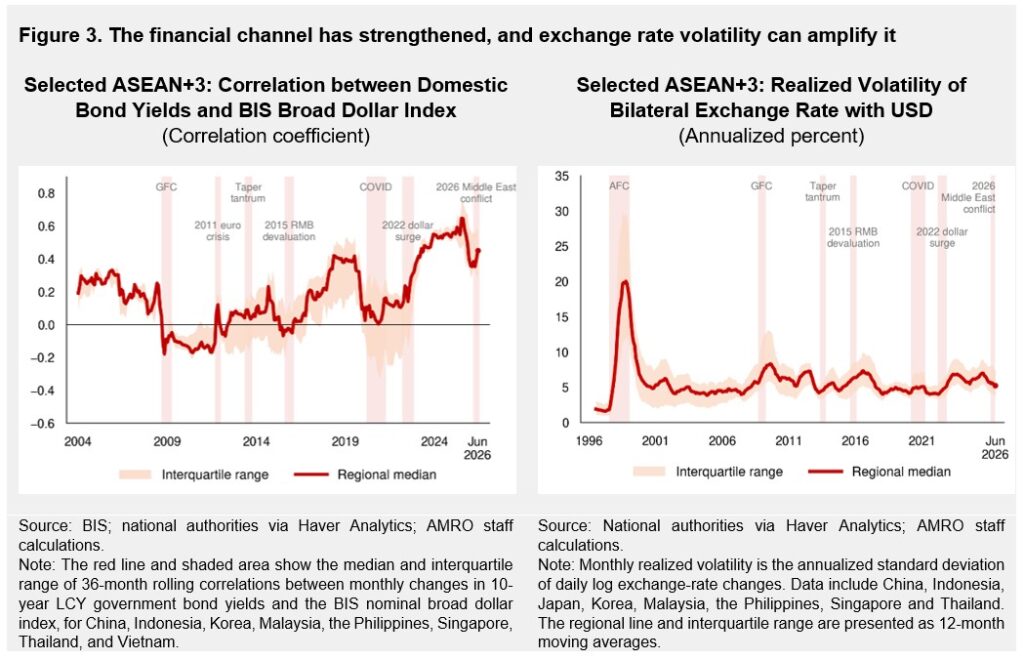
On the financial channel — we have moved from “original sin” to what Carstens and Shin call “original sin redux.” Local-currency bond markets removed the direct currency mismatch — but the risk migrated to foreign investors who measure returns in dollars. When the local currency depreciates, these investors suffer valuation losses, their risk limits bind, they retrench — and domestic bond yields rise. The data confirm this: the correlation between local-currency bond yields and the broad dollar index has risen substantially (Figure 3, left panel).
On the volatility channel — regional currency volatility has remained moderate overall since the Asian Financial Crisis but still spikes around major global shocks (Figure 3, right panel). During such episodes, investors demand greater compensation for holding local-currency assets. The higher risk premia push up domestic bond yields, reinforcing the tightening in financial conditions triggered by depreciation. In essence, volatility does not operate in isolation — it amplifies the financial channel, making the effects of depreciation on domestic financing conditions more severe.
To summarize: the trade channel and the financial channel work in opposite directions – and the trade channel has become more ambiguous, while the financial channel has become increasingly important.
This means the financial channel warrants greater attention, because it is where exchange rate movements can become damaging and where volatility can amplify the tightening of domestic financial conditions.
Volatility is a permanent feature of any asset price. For flexible exchange rate regimes, that is not a flaw but part of the mechanism: movements in the currency help the economy absorb shocks. When a currency depreciates, domestic assets become cheaper, potentially attracting capital back in and supporting the self-correcting role of flexible exchange rates. But this mechanism can break down. If depreciation triggers expectations of further depreciation, investors may pull back rather than step in, and the exchange rate can amplify the shock instead of absorbing it.
The question, then, is: under what conditions do exchange rate fluctuations act as a shock amplifier rather than a shock absorber? This is an empirical question — and it is what we turn to next.
Part 3: When It Matters
In this part of my speech, I ask a specific question: under what conditions do exchange rate movements amplify the pass-through of shocks to domestic financial conditions? We measure transmission through domestic bond yields and broader financial condition indices, where the financial channel bites first, rather than through GDP, where effects arrive later and through many confounding factors.
Using a panel of eight regional economies (China, Indonesia, Japan, Korea, Malaysia, the Philippines, Singapore, and Thailand) from 2000 to 2026, we test for conditions under which FX shocks pass through to domestic financial conditions. We classify episodes into four regimes – appreciation, small depreciation, large depreciation without extreme volatility, and amplification, defined as large depreciation coinciding with realized FX volatility above the country-specific 90th percentile.
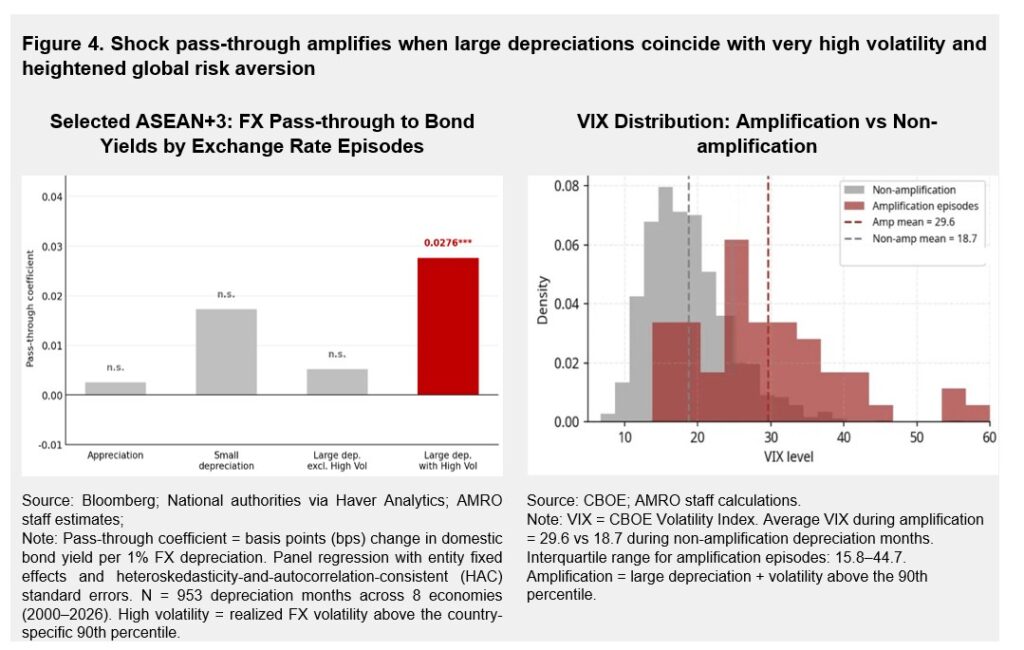
The key finding is that amplification occurs only when large depreciation coincides with high volatility (Figure 4, left panel). Appreciation, small depreciation, and even large depreciation without extreme volatility show no significant pass-through. Only when both conditions coincide does pass-through become significant and economically meaningful. In other words, the effect is nonlinear: neither depreciation nor volatility alone is sufficient; the risk emerges when they reinforce each other.
What are these amplification episodes? Most of them match known stress events – the GFC, the Taper Tantrum, COVID-19, the 2022 Fed tightening. They coincide with elevated global risk aversion – the VIX averages nearly 30 during amplification versus about 18 during normal depreciation months (Figure 4, right panel). In essence, these episodes are primarily driven by large, unexpected external shocks – major global crises that simultaneously affect multiple economies. At times, they also coincide with country-specific stress.
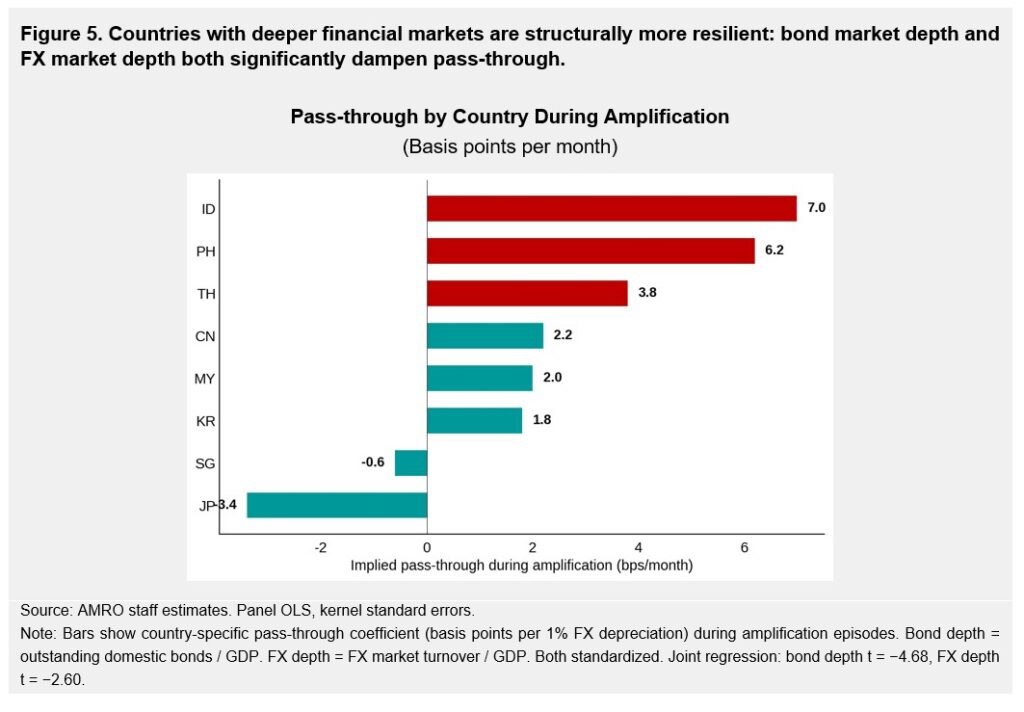
Moreover, the impact is not uniform across countries. Country fundamentals mitigate pass-through (Figure 5). Deeper bond markets — measured as outstanding domestic bonds relative to GDP — significantly dampen amplification. The intuition is straightforward: a large domestic bond market with a broad domestic investor base can absorb shocks more easily — if foreign investors panic and sell, domestic investors can step in without yields spiking as sharply. Deeper FX markets provide additional protection. Although there is still significant variation across regional economies after controlling for these factors, the direction is clear: structural market depth provides an important buffer.
This is consistent with the literature – a diversified domestic investor base dampens spillovers to local-currency bond markets (Ebeke and Kyobe 2015), and FX market depth shapes how emerging economies absorb external shocks (Juselius and Xia 2026).
Let me summarize. First, amplification is conditional: appreciation and small depreciation do not trigger pass-through; only large FX depreciation combined with extreme volatility produces significant spillovers to domestic financial conditions. Second, these episodes are primarily externally driven, coinciding with major global shocks rather than idiosyncratic domestic events. Third, country fundamentals provide a buffer: economies with deeper bond and FX markets experience significantly lower pass-through, regardless of conditions.
Part 4: What Are the Implications for Exchange Rate Management?
These findings give us a more precise way to think about policy. The issue is not whether exchange rates should move; flexible exchange rates must be allowed to absorb shocks. The issue is whether the movement is occurring under conditions in which depreciation and volatility reinforce each other, tightening domestic financial conditions rather than relieving them.
Our empirical findings point to a specific deployment logic for exchange rate management: lean against highly volatile depreciation when there is a risk that shocks will be amplified through domestic financial conditions, rather than defending particular exchange rate levels or smoothing routine fluctuations.
Is this what central banks in the region actually do in practice? Do they follow this broad logic?
Data show that regional central banks have essentially pioneered an operational model for FXI that bridges two major schools of thought: the cycle- and balance-sheet-based approach championed by the BIS (Borio and others 2022), and the frictions-based normative framework formalized in the IMF’s IPF (IMF 2023).
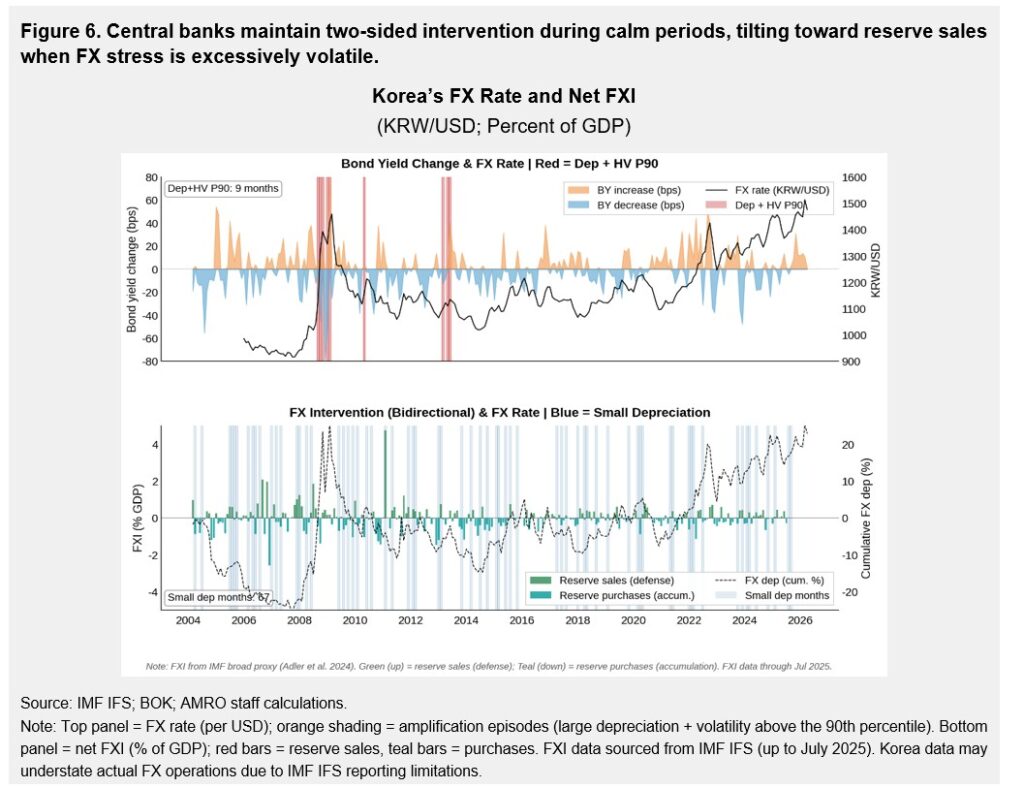
We observe that two-way operations are the norm: reserve purchases during appreciation and reserve sales during depreciation (Figure 6 illustrates this pattern using Korea as an example). But to understand this through the BIS lens, we must distinguish between strategic and tactical deployment. During periods of capital inflows and currency appreciation, central banks accumulate reserves. This should not be viewed merely as routine smoothing. Instead, it is strategic pre-funding designed to build macro-financial buffers against the broader global financial cycle and the outsized influence of the US dollar. Conversely, during acute stress, central banks deploy these reserves tactically to break negative feedback loops and provide emergency liquidity.
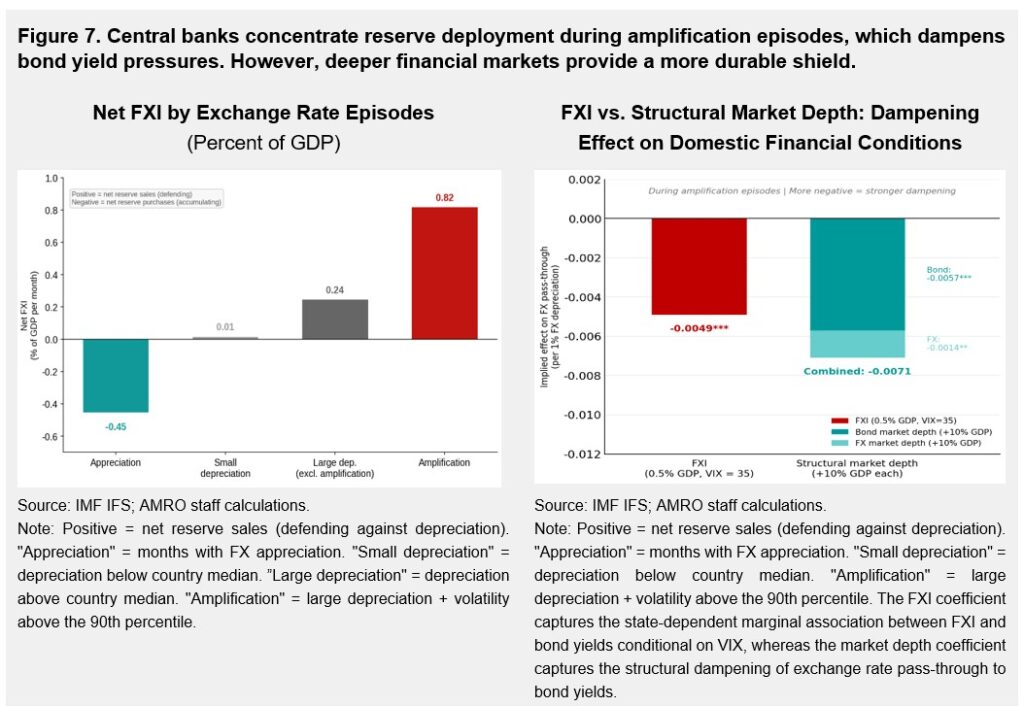
During amplification episodes, this tactical intervention visibly intensifies. Looking at the numbers, net FXI deployment jumps to 0.82 percent of GDP per month during amplification—three to four times larger than during normal large depreciations. But equally important is what happens during small depreciations: net deployment drops to a near-zero 0.01 percent (Figure 7, left panel).
This stark contrast directly answers a central tension in the IMF’s IPF: the risk of moral hazard. The IPF rightfully warns that routine, continuous intervention can incentivize the private sector to take on unhedged FX debt and stifle the organic development of private hedging markets. Asia’s practice appears to mitigate this concern. Net intervention close to zero in normal times leaves two-way flexibility largely intact, with firepower reserved for tail events.
What are these tail events? In our empirical work, the “amplification regime” brings together mechanisms identified by both frameworks. When large depreciation and extreme volatility collide, we see IPF Use Case A—where illiquidity in FX markets causes destabilizing premia to spike—operating alongside the channel the BIS terms original sin redux, where foreign investor retrenchment from local-currency bonds threatens systemic financial stability.
But is this tactical intervention effective? Dealing with endogeneity is challenging, as central banks intervene precisely when conditions deteriorate. To circumvent this, we draw on a general finding from the broader literature: FXI, if it is at all effective, tends to be state-dependent – it works better during periods of elevated stress.
We therefore test whether FXI’s mitigating impact on domestic financial conditions increases with global volatility. Indeed it does – FXI appears effective during large depreciation episodes that coincide with elevated global volatility, but not during calm periods such as small depreciations. This confirms that the benefits of intervention are concentrated in amplification conditions – exactly where central banks deploy it.
But here is an important nuance. FXI offers a powerful tactical buffer during crises, while deeper bond and FX markets provide a comparable — and more permanent — dampening effect (Figure 7, right panel). Unlike FXI, which is costly, finite, and requires active deployment, market depth operates as a structural buffer that does not deplete.
Let me distill these findings into three nuanced messages for operationalizing policy:
First, amplification is state-contingent. Our findings confirm it occurs only under specific conditions— consistent with IMF IPF’s advocacy for the state-contingent use of tools. Not all currency movements require a response.
Second, FXI is a tactical absorber, while market depth is a structural shield. Central banks deploy FXI during amplification, and it appears to be effective. But financial market depth provides the more durable, permanent defense against the global financial cycle.
Third, a holistic policy mix is both feasible and effective. Asia’s experience shows how to synthesize the IMF and BIS frameworks in real time, at least on the FX intervention leg: executing tactical intervention during acute stress based on friction thresholds, anchored by strategic reserve accumulation and structural market deepening for long-term resilience.
Caveats and Open Questions
What I have presented today are exploratory observations — an attempt to contribute to the discussion on how to address exchange rate volatility in a period of heightened uncertainty and fragmentation risks. It only focuses on the role of FXI and does not discuss how it can be combined with monetary policy tools (e.g., whether FXI helps alleviate the burden of adjustment in the policy interest rate), macroprudential policies and capital flow management measures.
Much more work is needed to understand the conditions under which exchange rate volatility becomes damaging through the financial channel, and the thresholds at which amplification risks emerge.
This matters because better understanding these conditions would allow policymakers to make more informed decisions – to make more optimal use of limited FX reserves without distorting the broader macroeconomy.
On the open questions, the room for further work is ample. For instance, when should central banks intervene during appreciation episodes in order to pre-fund and accumulate foreign exchange reserves? Are FX interventions during small depreciations — during normal times — necessary? Do they impede market development? Should central banks step in only during stress periods? This is difficult to answer because our observations are inherently ex post and lack a counterfactual: we cannot know what would have happened absent intervention. But it remains an important question for researchers and policymakers alike.
Then there are more operational questions: How much reserves should central banks accumulate and hold for those “amplification” episodes? What is the optimal size, pace, and duration of FXI during amplification, and when do diminishing returns set in? How should intervention be calibrated across different types of shocks? These are questions I hope future research can help address.
Conclusion
Let me conclude by returning to our opening question. When is currency volatility excessive?
We have seen that the exchange rate’s role appears to have shifted from trade to finance. Our evidence suggests that amplification occurs under specific conditions — when large depreciation coincides with extreme global volatility. And we observed that central banks deploy FXI precisely during these episodes, that it appears effective, but that structural market depth may provide a more durable shield.
Here are the three main messages I wish to convey:
First, “excessive” is a condition, not a number. Volatility becomes excessive when large depreciation coincides with extreme global shocks, amplifying stress through the financial channel. This is when state-contingent policy matters most.
Second, FXI is a tactical absorber, not a structural shield. It works during amplification. But financial market depth provides the more durable, permanent defense against the broader global financial cycle.
Third, Asia’s experience bridges theory and practice. By synthesizing the friction-based thresholds of the IMF’s Integrated Policy Framework with the dynamic balance-sheet focus of the BIS’s Macro-Financial Stability Framework, regional central banks demonstrate how a holistic FXI strategy works: tactical intervention during acute stress, anchored by structural market deepening for long-term resilience.
The way forward requires both. In a fragmented global economy where dollar-centric geopolitical shocks are increasingly the norm, we must deploy FXI tactically during acute stress, while investing heavily in deeper markets and credible frameworks. Over time, this ensures our financial systems can absorb more shocks before policy even needs to respond.
Thank you. I look forward to our discussion.
1I thank Allen Ng, Haobin Wang, and Yuhong Wu for their help preparing this speech.
References
- Adler, G., Lisack, N. and Mano, R. (2019). “Unveiling the Effects of Foreign Exchange Intervention: A Panel Approach”, Emerging Markets Review, 40, 100620
- Aghion, Philippe, and others (2009). “Exchange Rate Volatility and Productivity Growth: The Role of Financial Development.” Journal of Monetary Economics, 56(4), 494–513.
- Ahmed, Swarnali, Maximiliano Appendino and Michele Ruta (2017). “Global Value Chains and the Exchange Rate Elasticity of Exports.” The B.E. Journal of Macroeconomics, 17(1).
- Blanchard, Olivier, Gustavo Adler, and Irineu de Carvalho Filho (2015). “Can Foreign Exchange Intervention Stem Exchange Rate Pressures from Global Capital Flow Shocks?” NBER Working Paper No. 21427.
- Borio, Claudio, Ilhyock Shim and Hyun Song Shin (2022). “Macro-Financial Stability Frameworks: Experience and Challenges”, BIS Working Paper No 1057.
- Carstens, Agustín and Hyun Song Shin (2019). “Emerging Markets Aren’t Out of the Woods Yet.” Foreign Affairs, 15 March.
- Eichengreen, Barry and Ricardo Hausmann (1999). “Exchange Rates and Financial Fragility.” NBER Working Paper No. 7418.
- Ebeke, C. and Kyobe, A. (2015). “Global Financial Spillovers to Emerging Market Sovereign Bond Markets,” IMF Working Paper WP/15/141.
- Fratzscher, M., Gloede, O., Menkhoff, L., Sarno, L. and Stöhr, T. (2019), “When Is Foreign Exchange Intervention Effective? Evidence from 33 Countries”, American Economic Journal: Macroeconomics, 11(1), pp. 132–156.
- Gadanecz, Blaise, Ken Miyajima and Chang Shu (2018). “Emerging Market Local Currency Sovereign Bond Yields: The Role of Exchange Rate Risk.” International Review of Economics & Finance, 57, 371–401.
- Gopinath, Gita, and others (2020). “Dominant Currency Paradigm.” American Economic Review, 110(3), 677–719.
- Hofmann, Boris and Taejin Park (2020). “The Broad Dollar Exchange Rate as an EME Risk Factor.” BIS Quarterly Review, December.
- Hofmann, Boris, Ilhyock Shim and Hyun Song Shin (2020). “Bond Risk Premia and the Exchange Rate.” Journal of Money, Credit and Banking, 52(S2), 497–520.
- International Monetary Fund (2023). “Integrated Policy Framework—Principles For the Use of Foreign Exchange Intervention”, IMF Policy Papers.
- Juselius, Mikael and Xia, Dora (2026). “Monetary Responses to External Shocks in Emerging Market Economies: The Role of FX Market Depth,” BIS Quarterly Review, March 2026.
- Kearns, Jonathan and Nikhil Patel (2016). “Does the Financial Channel of Exchange Rates Offset the Trade Channel?” BIS Quarterly Review, December.