

SINGAPORE, May 22, 2026 – Recovery of the Hong Kong economy has gathered momentum in the past year despite heightened geoeconomic tensions and rising global trade protectionism. Following strong growth in 2025, the economy is expected to remain buoyant in the near term, with growth projected at 3.4 percent in 2026.
Amid heightened external uncertainty—including volatility in global energy prices and asset markets, and the possibility of a downturn in the global tech cycle—Hong Kong will need to carefully calibrate macroeconomic policies. Securing new growth drivers and addressing structural challenges will be important to broaden growth momentum across sectors and safeguard its position as a leading international business and financial hub.
This preliminary assessment was made by AMRO following its Annual Consultation Visit to Hong Kong, China from May 11-22, 2026.
The mission was led by AMRO Lead Economist Jae Young Lee. Policy discussions involved AMRO Director/CEO Yasuto Watanabe and Chief Economist Dong He, and focused on recent macroeconomic developments, policy initiatives to support growth, key risks and vulnerabilities, and efforts to strengthen long-term resilience.
Economic developments and outlook
“Hong Kong’s economic recovery has taken hold, reflecting buoyant external trade and financial market activities,” said Lee. “At the same time, growth has become increasingly uneven across sectors. Broadening growth momentum and fostering new growth drivers will be key.”
Hong Kong’s economy outperformed expectations in 2025, growing by 3.6 percent, supported by strong external demand and improved activity in tourism and financial services. Amid global trade tensions, Hong Kong’s role as a bridge between the Chinese Mainland and the rest of the world has become an important source of resilience.
However, the pace of economic recovery remains uneven across sectors. Externally oriented and financial sectors have expanded more rapidly than other service sectors. Employment growth in financing and business services also performed relatively better in the economy. Divergence has emerged within the property market, with the residential segment showing signs of recovery while commercial real estate remains subdued.
Growth in 2026 and 2027 is expected to remain higher than in recent years, supported by continued strength in exports and financial activity–key pillars of the economy. Reflecting the strong growth outlook, inflation is projected to rise to 2.0 percent in 2026 before easing to 1.6 percent in 2027.
Risks and vulnerabilities
As a super-connector between the Chinese Mainland and the rest of the world, Hong Kong’s economic outlook remains sensitive to geopolitical and geoeconomic developments. As the Sino-US relationship is expected to be stable in the period ahead, the overall balance of risks to Hong Kong’s economic outlook has improved compared to last year.
In the near term, uncertainties in the global technology cycle remain a key risk given Hong Kong’s high degree of global integration. At the same time, heightened volatility in global energy and financial markets could also weigh on growth, especially if such volatility leads to higher inflation, tighter financial conditions, and slower growth in the major economies.
On the domestic front, prolonged adjustment or renewed weakness in the property market could constrain growth momentum.
Over the medium-to-long term, population aging and intensifying geoeconomic fragmentation will remain key structural challenges. Failure to diversify growth drivers could make the economy less resilient to fluctuations in global trade and financial services.
Policy responses
With economic activity operating slightly above potential, the overall macroeconomic policy stance should be broadly neutral. Policy calibration should focus on maintaining macroeconomic stability, preserving policy space, and facilitating structural adjustment. Should any downside risks materialize, fiscal policy tools could be deployed swiftly to provide temporary and targeted support.
Current supportive macroprudential measures could be maintained to sustain credit conditions and facilitate economic transition. Policy efforts could focus on addressing the evolving financing needs of SMEs affected by geopolitical tensions and higher energy costs. Greater access to financing could also support the emerging sectors such as innovation and technology.
Broadening growth engines while addressing structural labor market challenges will be essential to achieving sustainable growth. Ongoing efforts to attract skilled talent should therefore continue.
AMRO supports the authorities’ proactive use of fiscal policy, particularly the increased emphasis on public investment and targeted development initiatives aimed at securing new growth drivers, which is conducive to attracting more private capital into new strategic projects. As fiscal policy takes on a more active role, greater attention to policy design, governance, and implementation will become increasingly important.
As Hong Kong starts to experiment with longer-term strategic planning, industrial policy should be disciplined and aim at helping to correct market failures and coordinate private sector participation in strategic initiatives. Competition policy should be given more prominence to preserve open and competitive markets. Such policies will be critical to Hong Kong’s efforts to diversify growth drivers into additional high value-added services sectors.
In the residential property market, sustaining the recovery momentum while meeting residents’ housing needs remains essential. Meanwhile, in the event of a disorderly adjustment in the commercial real estate segment, proactive policy responses may be needed to safeguard financial stability.
As renminbi internationalization advances, continued policy innovation and market infrastructure development will be important in reinforcing Hong Kong’s position as a leading international financial hub.
The mission team would like to express its sincere appreciation to the Hong Kong Monetary Authority and other organizations for their cooperation and candid engagement throughout the consultation.
About AMRO
AMRO is an international organization established to support macroeconomic resilience and financial stability of the ASEAN+3 region, comprising members of the Association of Southeast Asia Nations (ASEAN) and China; Hong Kong, China; Japan; and Korea. AMRO’s mandate is to conduct macroeconomic surveillance, support regional financial arrangements, and provide technical assistance to the members. AMRO also serves as a regional knowledge hub and provides support to ASEAN+3 financial cooperation.
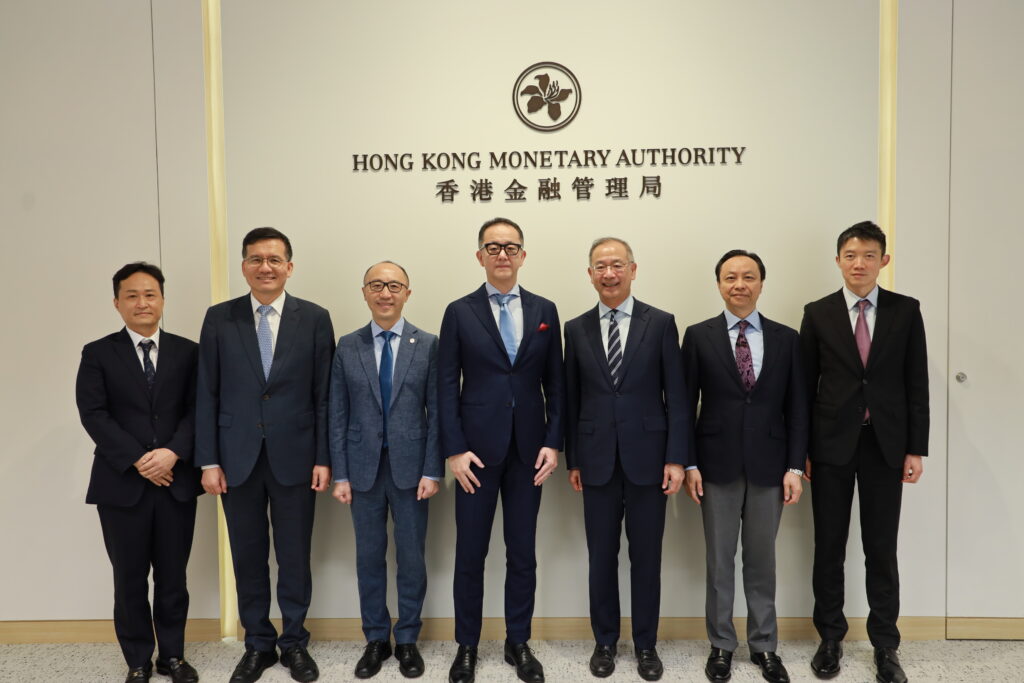
AMRO Director/CEO Yasuto Watanabe, Chief Economist Dong He and the mission team met with Chief Executive Eddie Yue and senior officials from the Hong Kong Monetary Authority.