

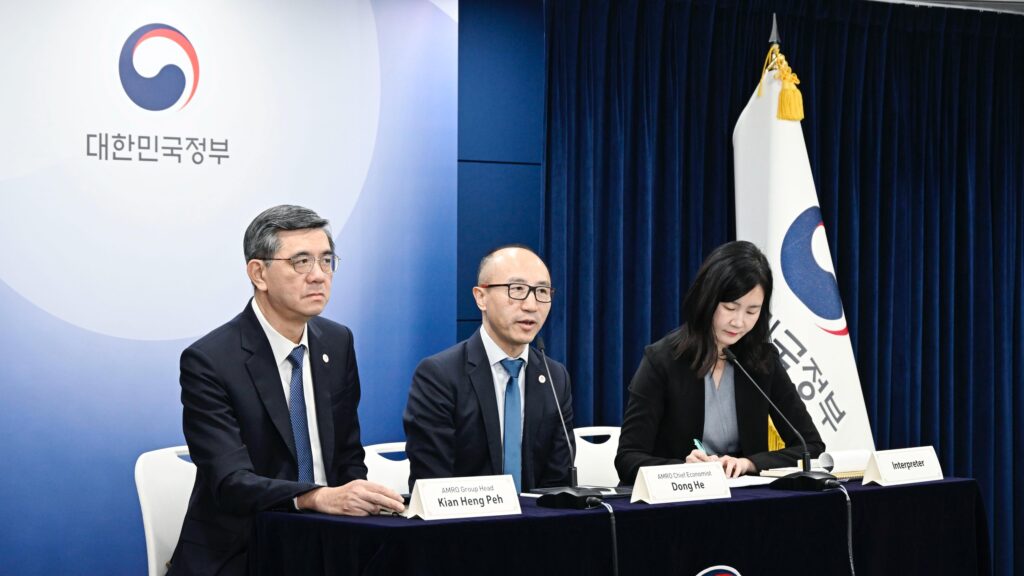
SINGAPORE, December 19, 2025 – The Korean economy has continued to recover steadily following the June presidential election, which ushered in an administration committed to a more proactive and coordinated policy stance. Fiscal and monetary policies have supported the economy amid rising global trade tensions and ongoing supply chain reconfiguration. Maintaining growth momentum while preserving macroeconomic stability and navigating geoeconomic fault lines will require carefully calibrated policies.
This preliminary assessment was made by the ASEAN+3 Macroeconomic Research Office (AMRO) following its Annual Consultation Visit to Korea from December 8 to 19, 2025. The mission was led by Lead Economist Kian Heng Peh. AMRO Director/CEO Yasuto Watanabe and Chief Economist Dong He participated in the policy discussions and met with Minister of Economy and Finance Yun Cheol Koo and Bank of Korea (BOK) Governor Chang Yong Rhee.
Economic developments and outlook
“Korea’s economy is rebounding in 2025, underpinned by a recovery in private consumption and resilient exports,” said Mr. Peh. “We project GDP growth at 1.0 percent in 2025 and 1.9 percent in 2026, narrowing the negative output gap.”
Inflation has remained close to the BOK’s target, helped by stable food prices and muted global energy costs. The recent increase in services prices reflects higher input costs. Looking ahead, inflationary pressures are expected to remain contained. Headline inflation is forecast to average 2.1 percent in 2025, moderating slightly to 1.9 percent in 2026.
The external sector remains strong, even as the won exchange rate depreciated amid continued net capital outflows by Korean residents. The current account surplus rose to 6.1 percent of GDP for the first three quarters of 2025, from 5.3 percent of GDP in 2024, driven largely by strong semiconductor exports amid the global AI boom. Foreign reserves cover about 2.6 times of short-term external debt, providing a substantial buffer against potential shocks.
To support recovery, the government implemented two supplementary budgets in May and July 2025 to assist small businesses and stimulate domestic demand. The managed fiscal deficit, excluding social security funds, is estimated to be higher than 4.1 percent in 2024.
In response to rising house prices in Seoul, authorities have rolled out a comprehensive mix of demand- and supply-side measures. These have helped moderate price pressures and transaction activity, though it may take some time to stabilize the market, particularly in speculative districts.
After lowering the policy rate by a cumulative 100 basis points between October 2024 and May 2025, the BOK has kept rates on hold for the remainder of 2025. Despite well-anchored inflation, concerns over financial stability risks stemming from increases in Seoul’s house prices and recent exchange rate volatility have supported maintaining the current monetary stance.
Risks, vulnerabilities, and challenges
Korea’s economy is well integrated with global supply chains, especially in semiconductors. Strong trade and investment linkages with major economies are Korea’s strength but could also make it vulnerable to potential escalation of trade and geopolitical tensions. External risks also include a sharper-than-expected growth slowdown in major economies and renewed commodity price shocks.
Domestic vulnerabilities stem from the possibility of abrupt price corrections in the Seoul housing market, the exposures of smaller regional savings banks and mutual credit cooperatives to impaired project finance loans and a shrinking labor force over the medium term.
Policy priorities
AMRO recommends maintaining the recovery while building resilience and safeguarding stability through a well-calibrated policy package:
- Monetary policy: The current stance remains appropriate given the complex balance of risks. While output growth remains suboptimal and inflationary pressure is contained, the persistent rise in Seoul’s housing prices and exchange rate considerations warrant caution. The improved outlook following the US-Korea trade agreement has also reduced the urgency of immediate policy support. Further rate cuts may be considered if downside risks to growth were to increase.
- Macroprudential and housing policies: Measures to cool the housing market and contain household debt should be complemented by steps to address underlying supply constraints. The government’s plan to expand housing supply over the next five years is welcome. Additional options include relaxing restrictions on reconstruction and redevelopment in sought-after districts, as well as releasing greenbelt areas for development. A multipronged strategy that encompasses education, health, and transportation policies may be needed to alleviate the demand-supply imbalance in the capital region’s housing market.
- Fiscal policy: The fiscal stance in the 2026 budget is broadly appropriate. With moderate fiscal space and monetary policy facing constraints, authorities should be prepared to deploy well-targeted fiscal measures if downside risks emerge. Temporary measures should be phased out once economic conditions normalize to maintain fiscal credibility. Establishing a credible fiscal anchor and advancing structural fiscal reforms will be critical for ensuring long-term fiscal sustainability amid a rising debt trend.
- Medium term growth and resilience: Strengthening the manufacturing sector’s resilience and overcoming demographic challenges are essential for sustaining long-term growth. Korea’s ambitious semiconductor strategy, aimed at evolving from being the world’s memory factory to becoming a full-spectrum semiconductor powerhouse, is an essential step to reinventing industrial growth. Diversifying production capacity into critical semiconductor segments will bolster supply chain resilience. At the same time, demographic policies should continue to evolve, including measures to raise labor force participation through workplace reforms that improve work-life balance, extending effective retirement age, and gradually liberalizing immigration to allow selective labor inflows in sectors facing acute skill shortages.
The AMRO team extends its appreciation to the Korean authorities and participating organizations for their cooperation and candid discussions during the mission.
Also available in Korean
About AMRO
The ASEAN+3 Macroeconomic Research Office (AMRO) is an international organization established to contribute to the macroeconomic and financial resilience and stability of the ASEAN+3 region, comprising members of the Association of Southeast Asian Nations (ASEAN) and China; Hong Kong, China; Japan; and Korea. AMRO’s mandate is to conduct macroeconomic surveillance, support regional financial arrangements, and provide technical assistance to the members. In addition, AMRO also serves as a regional knowledge hub and provides support to ASEAN+3 financial cooperation.